Markdown for layout intent
GitHub-flavored Markdown with a small, semantic vocabulary for layout.
Markus keeps GitHub Flavored Markdown as the content language, then adds a handful of colon-fenced directives for the things Markdown was never meant to say: this is a pull quote, these are peer cards, these two ideas belong beside each other.
The source stays diffable. The renderer decides whether that pairing becomes two columns, a stacked phone layout, or a print spread.
Encode intent in the document. Leave grid tracks, type ramps, and hover states to the theme.
Write this, get this
Every example in these docs shows the Markus source beside what it renders. This one is a callout and a metric inside a two-up pair.
Markus
:::two-up{ratio="2:1"}
:::column
### Ship the smaller model

It answers 94% of support questions on its own, at a tenth of the cost.

:::tip
Route the rest to the large model.
:::
:::

:::column
::metric{value="0.1" unit="x" label="Cost per answer" delta="-90%"}
:::
:::
Preview
Ship the smaller model
It answers 94% of support questions on its own, at a tenth of the cost.
- Cost per answer
- 0.1x-90%
Get started to install Markus, or browse the feature index for every directive and Markdown feature.
A vocabulary small enough to remember
Pull quote
An editorial quotation with optional attribution, tone, and alignment.
Card grid
Peer ideas that should read as a set, not a numbered list pretending to be a layout.
Two-up
A conceptual pairing: contrast, before/after, claim and caveat.
What belongs in the source
- The kind of block you mean
- A short, validated attribute set
- Nested Markdown, including other directives
- Document metadata in YAML front matter
What belongs in the theme
- Column counts that collapse on small screens
- Typography and color
- Print, EPUB, or email fallbacks
- Component-level accessibility rules
Ratios on a three-column track
two-up ratios count parts across three columns: 2:1 is two parts plus one; 1:2 is one plus two. Blocks outside two-up span the full width.
Primary (2 parts)
The narrative, claim, or longer explanation belongs in the wider column.
Aside (1 part)
Metadata, a caveat, or a short counterpoint.
Lead (1 part)
A label, qualifier, or setup line.
Body (2 parts)
Material that should dominate when the second column carries the weight.
Full width (all three columns)
Outside two-up, ordinary blocks span the entire track. Inside a card-grid, set span=full on a card to do the same.
Metrics as first-class facts
Leaf directives cover facts that should be extractable later, not just styled.
- CSS properties in the authoring API
- 0
- Markdown baseline
- GFM
- License
- MIT
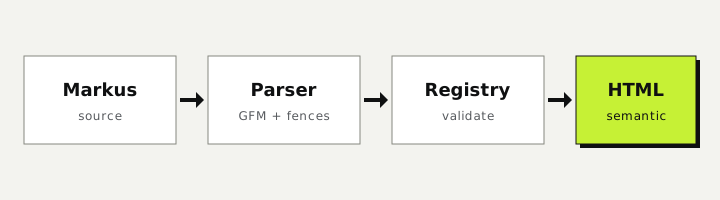
Structured procedures
1. Encode intent in source
Author content in GFM, wrapping layouts in colon-fenced directives.
2. Validate against strict schemas
Markus checks directives and attributes at compile time, rejecting rogue CSS.
3. Render accessible HTML
Output semantic markup ready for static hosting, responsive themes, or print.
Multi-platform instructions
Install into the current environment:
pip install anthus-markus
Install the markus command in its own environment:
pipx install anthus-markus
Add Markus to a uv project:
uv add anthus-markus
Project timeline
Initial Concept
Markus originated as a strict semantic layer for technical publishing.
Core AST & Validation
Implemented the markdown-it directive parser, Pydantic attribute validation, and early theme support.
Rich Directives & Themes
Added tabs, step lists, timelines, and 20+ accessible color palettes.
Conversations, diagrams, and examples
Added conversation transcripts, flow diagrams, bar charts, highlights, heading anchors, and side-by-side source examples.
Why not raw HTML?
Raw HTML is a compatibility hatch, not the authoring API. It names CSS classes, invites sanitizer fights, and cannot tell a renderer whether three boxes are a comparison, a feature set, or leftover layout. Markus keeps a registry: unknown names fail in CI instead of silently becoming untyped markup.